
30 Day Patient Growth Plan: A Step-by-Step Digital Marketing Guide for Clinics
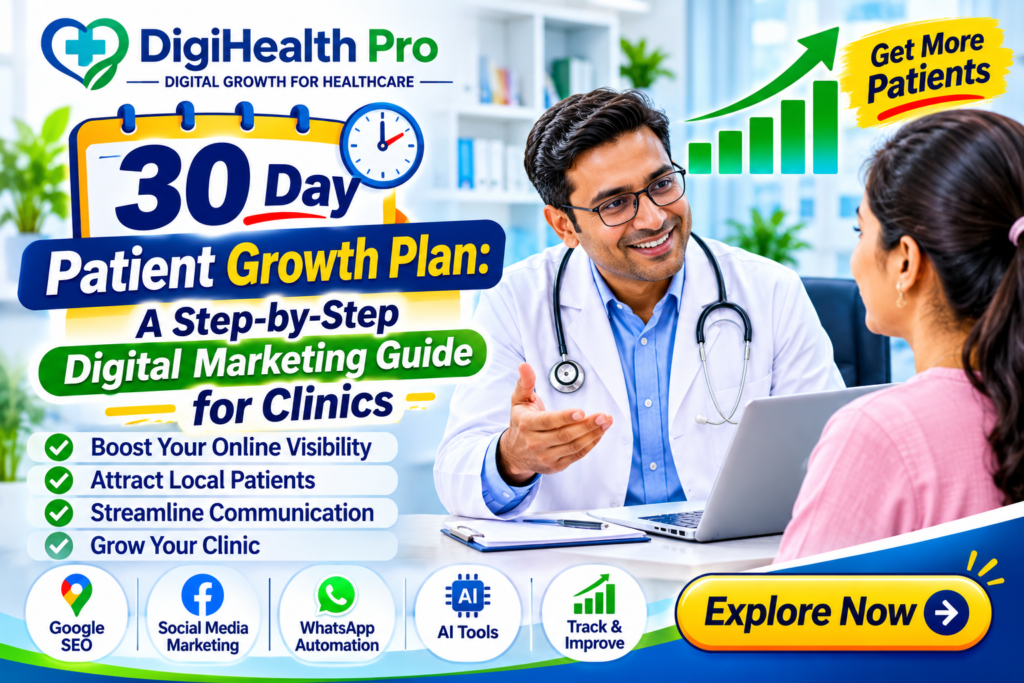
How Can Clinics Attract More Patient Enquiries, Improve Online Visibility and Build Stronger Patient Relationships in Just 30 Days?
The healthcare industry is changing rapidly. Today, patients do not depend only on traditional recommendations when choosing a doctor, clinic, hospital or diagnostic centre. Many people first search on Google, check online reviews, explore social media profiles and look for convenient ways to contact healthcare providers.
This creates an important opportunity for healthcare businesses.
Whether you own a small clinic, manage a hospital OPD, operate a pharmacy or run a diagnostic centre, having a strong digital presence can help people discover your services and communicate with your organisation more easily.
But where should you start?
Should you create a website? Should you run Facebook advertisements? Should you focus on Google Business Profile? Or should you start using WhatsApp automation and AI tools?
The answer is to follow a structured plan.
In this guide, we will explore a practical 30 Day Patient Growth Plan designed to help healthcare businesses strengthen their digital presence, improve patient communication and build a consistent online marketing system.
This is not a promise of guaranteed patient numbers. It is a practical implementation roadmap that you can start applying immediately.
What Is a 30 Day Patient Growth Plan?
A 30 Day Patient Growth Plan is a structured digital marketing action plan that helps healthcare businesses improve their online visibility, attract relevant enquiries and manage patient communication more effectively.
Instead of trying random marketing activities, you follow a clear schedule with specific tasks and measurable goals.
The plan focuses on five important areas:
- Digital foundation and healthcare branding.
- Google Business Profile and local SEO.
- Social media and educational content marketing.
- WhatsApp communication and automation.
- Performance tracking and continuous improvement.
The objective is simple: make it easier for potential patients to find your healthcare business, understand your services and contact you.
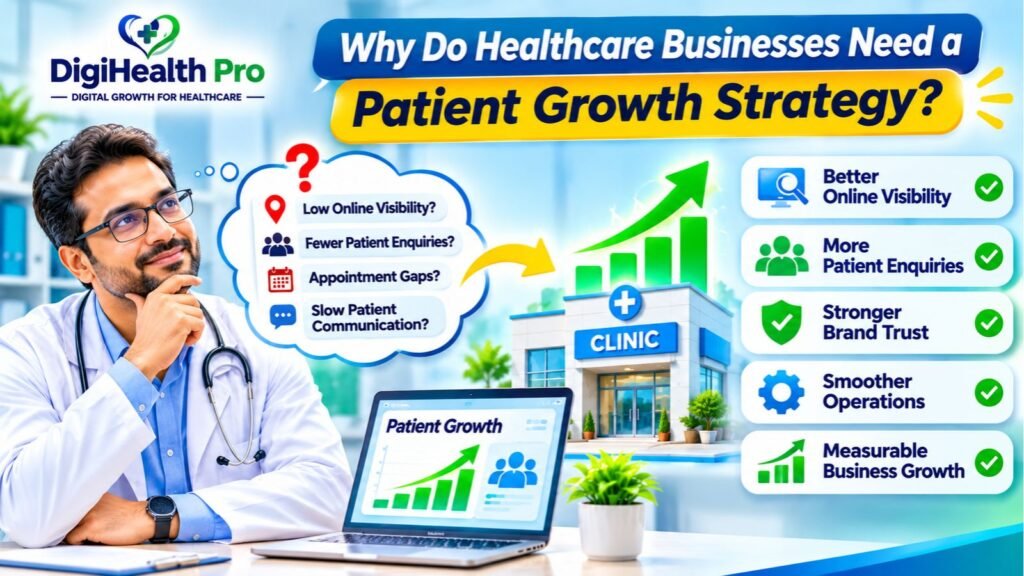
Why Do Healthcare Businesses Need a Patient Growth Strategy?
Many healthcare businesses provide excellent services but struggle to communicate their value online.
Consider these common situations:
- A patient searches for a nearby clinic but cannot find its correct address or contact information.
- A pharmacy has useful products and services but does not maintain an active online presence.
- A diagnostic centre receives enquiries but takes too long to respond.
- A clinic posts on Facebook occasionally but has no consistent content strategy.
- A hospital receives appointment enquiries through WhatsApp but does not have an organised follow-up process.
These problems can create unnecessary friction in the patient journey.
A proper digital marketing strategy can help address them.
Five benefits of a structured healthcare marketing plan
1. Better Online Visibility
Optimising your Google Business Profile and website can help your business become more discoverable in relevant local searches.
2. Stronger Patient Communication
A professional website, accurate contact information and organised WhatsApp communication make it easier for people to ask questions.
3. Improved Brand Trust
Educational content, transparent service information and genuine patient reviews can help establish credibility.
4. Better Administrative Efficiency
Appropriate AI and automation tools can reduce repetitive administrative tasks.
5. Measurable Marketing Performance
Tracking calls, website visits, appointment enquiries and other meaningful metrics helps you understand which activities are working.
Your Complete 30 Day Patient Growth Plan
Let’s divide the journey into four practical phases.
Week 1: Build Your Digital Foundation (Days 1–7)
The first week is about creating a professional and trustworthy online presence.
Before spending money on advertisements, make sure people can find your business and understand what you offer.
Day 1: Define Your Healthcare Business Goals
Start by identifying what you want to achieve.
For example:
- Increase relevant appointment enquiries.
- Improve local online visibility.
- Promote a particular medical service.
- Improve communication with existing patients.
- Increase awareness of your clinic or diagnostic centre.
Choose two or three measurable objectives for the next 30 days.
Day 2: Understand Your Target Audience
Not everyone searching online is looking for the same healthcare service.
Identify the people you want to reach.
Consider:
- Their location.
- The healthcare services they are searching for.
- Their common questions.
- Their preferred communication channels.
- The information they need before contacting your clinic.
For example, a physiotherapy clinic may create educational content about back pain, posture and rehabilitation services.
A diagnostic centre may focus on explaining available tests, preparation instructions and booking procedures.
Day 3: Optimise Your Google Business Profile
Your Google Business Profile is an important tool for local healthcare visibility.
Check the following:
- Correct business name.
- Accurate address and map location.
- Updated phone number.
- Working website link.
- Appropriate business category.
- Accurate opening hours.
- Relevant service information.
- Recent and genuine photographs.
Write a clear business description explaining your services and location.
Avoid keyword stuffing, fake reviews and misleading claims.
Day 4: Create a Professional Website
A website provides a central place where people can learn about your healthcare business.
Your website should ideally include:
- Home page.
- About section.
- Doctor or professional profiles.
- Services and departments.
- Contact information.
- Location and directions.
- Appointment enquiry option.
- Frequently Asked Questions.
- Privacy policy.
Make sure the website works properly on mobile devices.
Day 5: Set Up Your Social Media Profiles
Select the platforms that make sense for your audience.
For many local healthcare businesses, Facebook and Instagram can be useful starting points.
Create professional profiles with:
- Consistent business branding.
- Clear profile photographs or logos.
- Service descriptions.
- Contact details.
- Website link.
- Location information.
- A clear call to action.
Day 6: Set Up WhatsApp Business
WhatsApp Business can simplify communication with prospective and existing patients.
Set up:
- Business profile.
- Address and working hours.
- Service information.
- Greeting message.
- Away message.
- Quick replies.
- Appropriate labels for organising conversations.
Use these features to respond efficiently without sharing confidential patient information unnecessarily.
Day 7: Establish Your Baseline
Record your current performance before beginning your campaign.
Measure:
- Google Business Profile views and interactions.
- Website visitors.
- Phone calls.
- WhatsApp enquiries.
- Appointment requests.
- Social media reach.
- Actual appointments, where appropriately tracked.
This baseline will help you compare performance at the end of the month.
Week 2: Improve Local Visibility and Content Marketing (Days 8–14)
Now that your digital foundation is ready, focus on helping your local audience discover your business.
Day 8: Conduct Local Keyword Research
Identify the phrases people may use when searching for your services.
Examples:
- Best clinic in [your location].
- Orthopaedic doctor near me.
- Diagnostic centre in [your location].
- Physiotherapy clinic in [your location].
- Pharmacy near me.
Use relevant keywords naturally in your website content and service descriptions.
Do not use the same keyword repeatedly without adding useful information.
Day 9: Improve Your Service Pages
Create individual pages for important services.
For example, an orthopaedic clinic could have separate pages for:
- Knee pain consultation.
- Joint replacement services.
- Sports injury consultation.
- Back pain evaluation.
Each page should explain the service clearly, provide accurate information and tell visitors how to contact the clinic.
Day 10: Publish Your First Educational Blog
Start publishing helpful healthcare-related articles.
Possible topics include:
- How to Choose the Right Healthcare Clinic.
- Common Questions to Ask Before a Diagnostic Test.
- Why Regular Health Check-ups Matter.
- Understanding Physiotherapy and Rehabilitation.
- How to Prepare for a Doctor’s Appointment.
Educational articles can improve your website’s usefulness and support organic search visibility over time.
Day 11: Create Your First Educational Reel
Create a short video answering one common question.
A simple format:
- Start with a question.
- Explain the topic in simple language.
- Share useful educational information.
- End with an appropriate call to action.
Example:
“Looking for a physiotherapy clinic? Here are three things you should check before choosing one.”
Ensure medical information is reviewed by an appropriately qualified healthcare professional.
Day 12: Publish Your Clinic Introduction Post
Introduce your healthcare business.
Include:
- Who you are.
- What services you provide.
- Where you are located.
- Your working hours.
- How people can contact you.
Keep the information accurate and easy to understand.
Day 13: Build a Review Management System
Patient reviews can influence how people evaluate a healthcare business.
Create a simple process to request honest feedback from patients after their experience.
Remember:
- Never purchase fake reviews.
- Do not pressure patients to leave positive reviews.
- Do not reveal patient identities or treatment details in public replies.
- Follow applicable professional and platform guidelines.
Respond politely and professionally to feedback.
Day 14: Review Your First Two Weeks
Evaluate your progress.
Ask yourself:
- Is the Google Business Profile complete?
- Are the contact details correct?
- Have you published useful content?
- Are people interacting with your online profiles?
- Are enquiries being answered promptly?
Identify the three most important improvements for the next week.
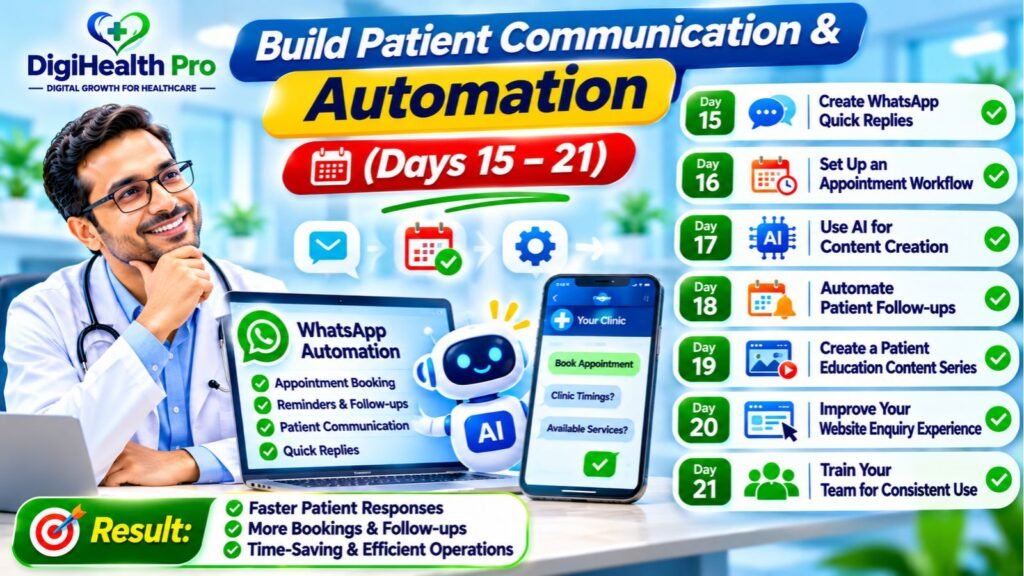
Week 3: Build Patient Communication and Automation (Days 15–21)
Visibility is only one part of the patient journey.
When someone contacts your clinic, the next step is to provide clear, timely and professional communication.
This is where WhatsApp Business and AI-assisted workflows can help.
Day 15: Create WhatsApp Quick Replies
Prepare answers to frequently asked administrative questions.
Examples:
- Clinic address.
- Working hours.
- Appointment booking procedure.
- Available services.
- Contact information.
Quick replies help your team respond consistently.
Day 16: Create an Appointment Enquiry Workflow
Design a simple process for handling enquiries.
A basic workflow:
- A person contacts your clinic.
- Your team acknowledges the enquiry.
- The person receives relevant booking information.
- Appointment availability is confirmed by authorised staff.
- The person receives appropriate confirmation.
Do not allow an automated system to make clinical decisions or promise treatment outcomes.
Day 17: Introduce AI for Content Creation
AI tools can help your team create first drafts of:
- Social media captions.
- Educational blog outlines.
- Frequently Asked Questions.
- WhatsApp administrative messages.
- Content calendars.
- Promotional copy.
Always review AI-generated content before publishing, especially medical information.
Day 18: Create an Automated Follow-up Process
Develop an appropriate follow-up system for people who have requested information or appointments.
Examples:
- Appointment confirmation.
- Appointment reminders.
- Rescheduling information.
- Requested service details.
Obtain appropriate consent, respect communication preferences and provide an easy way to stop promotional messages.
Day 19: Create a Patient Education Content Series
Plan a series of educational posts around your healthcare services.
For example:
- Monday: Common health question.
- Tuesday: Doctor introduction.
- Wednesday: Educational infographic.
- Thursday: Frequently Asked Question.
- Friday: Service information.
- Saturday: Health awareness video.
- Sunday: Weekly educational summary.
Consistency is more important than publishing a large quantity of low-quality content.
Day 20: Improve Your Website Enquiry Experience
Review your website from a visitor’s perspective.
Check:
- Is the phone number visible?
- Is the WhatsApp link working?
- Can visitors find the clinic address?
- Are services explained clearly?
- Is the booking process simple?
- Does the website load properly on mobile?
Remove unnecessary steps that make it difficult for people to contact your business.
Day 21: Train Your Team
Digital systems work best when the people using them understand the process.
Train relevant staff members on:
- Handling enquiries.
- Using WhatsApp Business.
- Managing appointment requests.
- Updating service information.
- Protecting patient information.
- Escalating clinical questions to qualified professionals.
Automation should support your team, not replace appropriate human judgement.
Week 4: Measure, Improve and Scale (Days 22–30)
The final phase is about evaluating your work and deciding what to improve next.
Day 22: Review Google Business Profile Performance
Check available performance insights.
Look for:
- Search visibility.
- Profile views.
- Website clicks.
- Calls.
- Direction requests.
Compare the results with your initial baseline.
Day 23: Review Social Media Performance
Identify which content receives meaningful engagement.
Look at:
- Reach.
- Video views.
- Saves.
- Shares.
- Profile visits.
- Relevant enquiries.
Do not judge success only by likes and followers.
Day 24: Analyse Website Performance
Use appropriate analytics tools to understand:
- Website visitors.
- Traffic sources.
- Popular pages.
- Mobile usage.
- Contact button clicks.
- Enquiry form submissions.
Check whether visitors can find the information they need.
Day 25: Review WhatsApp Communication
Evaluate your enquiry handling process.
Ask:
- How quickly are enquiries acknowledged?
- Are common questions answered consistently?
- Are appointment requests organised?
- Are follow-ups appropriate and consent-based?
- Are any enquiries being missed?
Improve the process where necessary.
Day 26: Identify Your Best-Performing Content
Review your published content.
Find the topics that generated the most useful engagement.
Create more educational content around those subjects, while ensuring the information remains accurate and relevant.
Day 27: Improve Your Local SEO
Review your website pages, business information and local search strategy.
Check that:
- Business details are consistent.
- Important service pages are useful.
- Location information is accurate.
- Website links work.
- Relevant internal links are included.
Avoid shortcuts such as buying backlinks or creating fake business locations.
Day 28: Explore Paid Advertising Carefully
If your digital foundation is ready, consider whether paid advertising is appropriate for your business.
Before launching a campaign:
- Define your objective.
- Identify your target location.
- Set a realistic budget.
- Create accurate advertisements.
- Build a relevant landing page.
- Establish a way to measure enquiries.
Healthcare advertising is subject to platform policies and applicable laws and professional requirements. Review these before publishing any campaign.
Day 29: Prepare Your Next 30-Day Content Calendar
Plan the next month’s content in advance.
Include:
- Educational blogs.
- Short videos.
- Social media posts.
- Frequently Asked Questions.
- Service information.
- Health awareness content.
- Appropriate promotional messages.
Use AI to assist with planning, but maintain human review and professional accuracy.
Day 30: Complete Your Growth Review
Congratulations! You have completed the first 30 days of your implementation roadmap.
Now compare your current performance with the baseline recorded on Day 7.
Review:
- Changes in online visibility.
- Website traffic.
- Phone and WhatsApp enquiries.
- Appointment requests.
- Content engagement.
- Response times.
- Operational improvements.
Identify what worked, what did not work and what needs more attention.
Remember: meaningful healthcare business growth is an ongoing process. Thirty days can help you build a stronger foundation, but sustained improvement requires consistent implementation.
The 30-Day Patient Growth Plan at a Glance
| Days | Main Focus | Key Activities |
|---|---|---|
| 1–7 | Digital Foundation | Branding, audience, Google Profile, website, social media, WhatsApp |
| 8–14 | Local Visibility | Local SEO, service pages, blogs, reels, reviews |
| 15–21 | Communication & Automation | Quick replies, AI content, appointment workflows, team training |
| 22–30 | Measurement & Improvement | Analytics, performance reviews, SEO, advertising readiness, next-month planning |
Five AI Prompts Healthcare Businesses Can Start Using
AI can help simplify content planning and administrative communication. Here are five practical prompts.
Prompt 1: Google Business Profile Description
“Act as a local SEO content writer. Write a professional Google Business Profile description for my healthcare business. My business type is [business type], my location is [location], and my services are [services]. Use natural local keywords and clear, accurate language. Do not include unverified medical claims.”
Prompt 2: Healthcare Social Media Calendar
“Create a 30-day social media content calendar for my [clinic/pharmacy/hospital/diagnostic centre]. My target audience is [audience] in [location]. Include educational topics, frequently asked questions, service information and awareness posts. Keep the content ethical and patient-friendly.”
Prompt 3: WhatsApp Quick Replies
“Create 10 professional WhatsApp Business quick replies for a healthcare organisation. Include appointment enquiries, clinic timings, location, service information and general administrative questions. Do not provide medical diagnoses or treatment advice.”
Prompt 4: Healthcare Blog Ideas
“Generate 20 SEO-friendly blog topics for a [type of healthcare business] serving [location]. Focus on useful educational information, common questions and relevant healthcare services. Avoid misleading medical claims.”
Prompt 5: Monthly Marketing Performance Review
“Act as a healthcare digital marketing analyst. Help me review the following monthly marketing data: website visitors [number], Google Business Profile interactions [number], phone enquiries [number], WhatsApp enquiries [number], appointment requests [number]. Identify trends, possible improvement areas and practical next steps. Do not assume that every enquiry resulted in a patient visit.”
Important Healthcare Marketing Principles
Digital marketing in healthcare requires greater responsibility because it involves people’s health, personal information and trust.
Always follow these principles:
- Protect patient privacy and confidential information.
- Obtain appropriate consent before using patient photographs, testimonials or stories.
- Never publish misleading medical claims.
- Avoid guaranteed patient acquisition or treatment outcomes.
- Ensure medical information is reviewed by qualified professionals.
- Follow applicable advertising, data protection and professional regulations.
- Use AI for assistance, not as a replacement for clinical judgement.
Trust is the foundation of healthcare marketing. A strong digital strategy should strengthen that trust, not compromise it.
Final Thoughts: Start Your 30-Day Healthcare Digital Growth Journey
You do not need to implement every digital marketing tool on the first day.
Start with the basics.
Make your Google Business Profile accurate. Build a useful website. Publish educational content. Set up WhatsApp Business. Introduce appropriate AI tools. Measure your performance.
Then improve one step at a time.
The most successful digital strategy is not necessarily the one that uses the most tools. It is the one that consistently helps people discover accurate information, communicate with your healthcare organisation and access the services they need.
At DigiHealth Pro, our mission is to make digital marketing, AI and automation easier to understand and implement for healthcare businesses.
Don’t just run a healthcare business. Build a trusted healthcare brand in the digital world.
Ready to Make Your Healthcare Business Digitally Smarter?
Explore DigiHealth Pro to learn practical digital marketing, Google visibility, WhatsApp automation, AI tools and healthcare business growth strategies.
DigiHealth Pro – People | Technology | Better Healthcare
Learn Digital. Build Trust. Communicate Better. Grow Smarter.
Explore Now: https://digihealthpro.com/